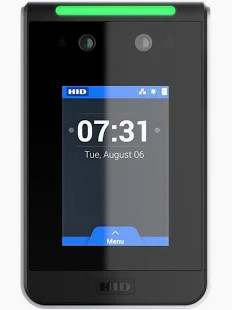
HID Biometric Readers & Fingerprint Access Control
HID biometric readers are access control devices that use biometric information to help verify a user's identity. Traditional card readers primarily verify possession of a compatible credential, while a biometric reader adds another factor by comparing a biometric sample presented by the user with enrolled biometric data associated with that person.
```
Fingerprint recognition is one of the most common biometric technologies used in physical access control. Depending on the system, biometric readers may be used for fingerprint-only authentication, card-plus-fingerprint authentication, multi-factor access control, higher-security entry points, and identity verification in regulated or sensitive environments.
```
```
How Fingerprint Biometric Readers Work
Fingerprint biometric systems begin with enrollment. During enrollment, the system captures fingerprint information and converts selected characteristics into a biometric template. The template is then associated with the authorized user according to the system's configuration and security architecture.
When the user later presents a finger at the reader, the system captures a new biometric sample and compares it with the enrolled template. If the comparison meets the system's configured matching criteria and all other access requirements are satisfied, the access control system can authorize entry.
HID Multispectral Fingerprint Imaging
Certain HID biometric readers use multispectral fingerprint imaging technology. Multispectral imaging is designed to capture fingerprint information from multiple optical characteristics of the finger rather than relying only on the visible surface pattern.
This approach can improve fingerprint acquisition in conditions that may be challenging for conventional optical fingerprint sensors. Performance can still vary based on the individual user, environment, enrollment quality, reader configuration, and specific HID biometric model.
```
```
Fingerprint Conditions HID Multispectral Imaging May Help Address
Depending on the reader and installation, multispectral imaging may help improve fingerprint capture when users have conditions that make fingerprint recognition more difficult.
- Dry skin
- Moist skin
- Worn fingerprints
- Dirty fingers
- Work-related skin wear
- Other conditions that make fingerprint capture more difficult
```
```
Key Features of HID Biometric Readers
Depending on the specific HID biometric reader, available features may include:
Fingerprint Recognition
Uses enrolled fingerprint data to help verify an authorized user.
Multispectral Imaging
Available on certain HID biometric products to improve fingerprint capture across a wider range of finger and environmental conditions.
Presentation Attack Detection
Certain products include technologies designed to help detect artificial fingerprint presentations.
Contactless Credential Support
Some HID biometric readers can also support compatible smart cards or other contactless credentials.
Multi-Factor Authentication
Depending on the system configuration, biometric verification can be combined with another credential factor.
OSDP Communication
Certain HID readers may support OSDP for reader-to-controller communication.
Outdoor & Environmental Ratings
Selected biometric reader models may be designed for outdoor or demanding environments.
Always review the specifications of the individual reader because biometric capabilities, credential support, communications, and environmental ratings vary by model.
```
```
Biometric Authentication vs. Card-Based Access
Card-based access control and biometric access control solve different parts of the identity problem. A card reader confirms that a compatible credential has been presented, while a biometric reader helps verify a biological characteristic associated with the enrolled user.
For many organizations, biometric verification can be used at locations where a higher level of identity assurance is justified rather than replacing card-based access everywhere.
- General office doors may continue using cards or mobile credentials.
- Server rooms may require a card plus fingerprint.
- Research areas may use multi-factor authentication.
- Medication storage or controlled areas may require enhanced identity verification.
- High-security facilities may apply different authentication policies by door or user group.
This allows organizations to match authentication requirements to the actual risk associated with each area.
```
```
Card Plus Fingerprint Authentication
Some biometric access control deployments use two-factor authentication. In this configuration, the user may be required to present both:
1. A Valid Access Credential
2. A Matching Fingerprint
Requiring two separate authentication factors can provide stronger identity assurance than relying on possession of a card alone. If a card is lost, borrowed, or stolen, biometric verification may help prevent that credential from being successfully used by an unauthorized person.
The exact authentication options available depend on the HID biometric reader, credential technology, access control software, and system configuration.
```
```
Where HID Biometric Readers May Be Used
Biometric readers can be appropriate where organizations need stronger identity verification or where credential sharing creates unacceptable risk. Common applications can include:
Government Facilities
Healthcare Organizations
Data Centers
Research Laboratories
Manufacturing Facilities
Energy & Utility Environments
Financial Operations
Corporate Security Areas
Pharmaceutical & Controlled Storage
High-Value Inventory Areas
Critical Infrastructure
Other Restricted-Access Locations
Biometric access does not necessarily need to be deployed at every door. Many organizations use biometric authentication only at selected high-security entry points.
```
```
HID Biometric Readers for Industrial Environments
Industrial and manufacturing environments can present unique challenges for fingerprint recognition. Employees may have worn fingerprints, dry skin, dirt, moisture, or other conditions that can affect fingerprint capture.
When selecting a biometric reader for an industrial application, consider:
- Fingerprint sensor technology
- Expected condition of users' hands
- Indoor or outdoor location
- Temperature and environmental exposure
- Dust and moisture ratings
- Protective equipment requirements
- Reader mounting location
- Authentication speed and throughput
- Enrollment procedures
HID Biometric Readers for Healthcare
Healthcare environments may use biometric verification in areas where access must be tightly controlled.
Potential applications include:
- Medication storage
- Pharmacy areas
- Sensitive records locations
- Laboratories
- Restricted clinical areas
- Equipment rooms
- Staff-only areas
Biometric deployment in healthcare should be planned carefully because users may wear gloves, use sanitizers frequently, or have other working conditions that affect fingerprint capture.
```
```
Biometric Presentation Attack Detection
Some HID biometric reader technologies include presentation attack detection, often referred to as liveness detection or spoof detection. These capabilities are designed to help identify attempts to present artificial or non-live fingerprint materials to the sensor.
Presentation attack detection can add another layer of protection in higher-security access control environments, but no biometric technology should be treated as an absolute guarantee against every possible spoofing method. Organizations with high security requirements should evaluate biometric performance, authentication policies, system architecture, and applicable compliance requirements as part of the complete access control design.
```
```
Privacy and Biometric Data Considerations
Biometric access control requires additional planning because biometric information is more sensitive than a conventional card number. Organizations deploying biometric readers should establish appropriate policies for:
Enrollment
Biometric Template Storage
User Consent Where Required
Data Retention
Access to Biometric Information
Template Deletion
Employee & Visitor Offboarding
System Security
Applicable Privacy & Biometric Data Laws
Legal requirements can vary by jurisdiction. Organizations should review applicable laws, contractual requirements, cybersecurity policies, and internal privacy procedures before deploying biometric identity systems.
```
```
Choosing the Right HID Biometric Reader
Before selecting an HID biometric reader, consider the complete access control environment. Important questions include:
- Is fingerprint authentication required by itself or as part of multi-factor authentication?
- Will users also present HID smart cards, mobile credentials, or other credentials?
- What access control platform and controller are being used?
- Does the system require OSDP, Wiegand, or another communication method?
- Will the reader be installed indoors or outdoors?
- What environmental conditions will users and the reader encounter?
- What throughput is required at the door?
- How will users be enrolled?
- Where and how will biometric templates be stored and managed?
- What privacy or compliance requirements apply?
Answering these questions before ordering can help ensure that the biometric reader fits both the technical requirements and the organization's security policy.
```
```
Are HID Biometric Readers Right for Your Facility?
HID biometric readers can be a strong option when your organization needs more identity assurance than possession of a card or knowledge of a PIN alone can provide. They are particularly worth considering for high-security doors, sensitive environments, regulated facilities, or applications where credential sharing or unauthorized credential use creates significant risk.
Biometric readers should be evaluated as one part of the complete access control system rather than as a standalone security solution. Reader compatibility, credential technology, access control software, biometric enrollment, system architecture, environmental conditions, and privacy requirements should all be reviewed before deployment.
```
```
Shop HID Biometric Readers
Browse HID biometric readers and related access control solutions for commercial, institutional, industrial, healthcare, government, and other high-security applications.
Compare fingerprint technologies, credential support, authentication options, reader communication, environmental ratings, and system requirements to identify the HID biometric solution appropriate for your access control environment.
Not sure which HID biometric reader is compatible with your existing system? Contact ID Enhancements with information about your access control platform, existing readers or credentials, controller communication requirements, installation environment, and desired authentication method so we can help narrow down the appropriate biometric reader options.
```