Employee ID Cards for Manufacturing: What Should Your Badge Include?
1st Oct 2026
Employee ID Cards for Manufacturing: What Should Your Badge Include?
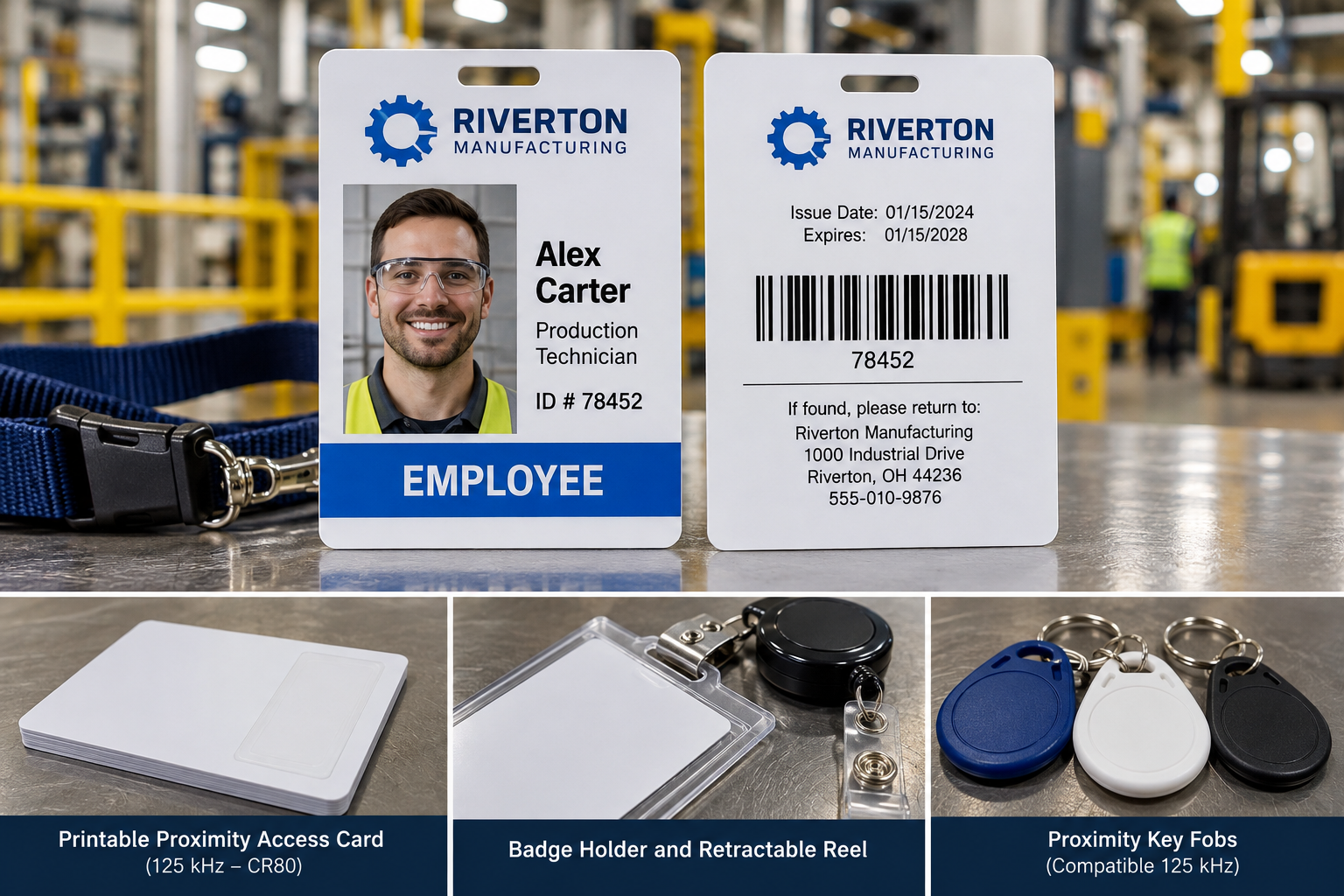
Employee ID cards for manufacturing should include a clear employee photo, readable name, company identification, department or job role, and a unique employee ID number. Depending on the facility, manufacturing badges may also incorporate RFID access control technology, barcodes, color-coded identification, expiration dates, and additional security features.
But designing an effective manufacturing employee ID badge involves more than deciding what information to print.
Factory floors, warehouses, production plants, and industrial facilities present unique challenges. Employee badges must remain readable through daily use, work with existing security systems, and accommodate workplace safety requirements.
A properly designed badge program can help organizations:
- Identify employees, contractors, and visitors quickly.
- Support controlled entry to buildings and restricted departments.
- Integrate employee identification with compatible timekeeping systems.
- Improve visual identification across departments and shifts.
- Reduce replacement costs through appropriate card materials.
- Support consistent credential issuance and deactivation procedures.
This guide explains what to include on manufacturing employee ID badges, which card materials and technologies to consider, and how to select identification supplies for industrial workplaces.
1. What Information Should Be on a Manufacturing Employee ID Card?
The best manufacturing ID card designs prioritize clear identification without overwhelming the badge with unnecessary information.
A standard CR80 employee ID card measures approximately 3.375 × 2.125 inches, providing limited space for identification, branding, and security information.
The front should display essential information that coworkers and authorized personnel can recognize quickly. The back can accommodate supporting identification and administrative details.
|
Badge element |
Recommended placement |
Purpose |
|
Employee photograph |
Front |
Supports visual identification |
|
Employee name |
Front |
Makes the badge wearer identifiable |
|
Company name or logo |
Front |
Identifies the issuing organization |
|
Department or job title |
Front |
Distinguishes personnel and responsibilities |
|
Employee ID number |
Front or back |
Connects the badge to an internal employee record |
|
Employee, contractor, or visitor designation |
Front |
Identifies personnel classification |
|
Expiration date |
Front for temporary credentials |
Helps identify expired credentials |
|
Barcode or QR code |
Front or back |
Supports compatible scanning applications |
|
Security contact or return instructions |
Back |
Helps manage lost or misplaced badges |
|
RFID or proximity technology |
Embedded in compatible cards |
Supports electronic access applications |
Best practice: Use a clean design with strong contrast, appropriately sized text, and a recognizable photograph.
Before approving a design, print a sample and examine it under actual factory lighting and through the badge holder employees will use.
Should Manufacturing Badges Display Personal Information?
Employee identification cards should contain only information necessary for their intended purpose.
Avoid printing:
- Home addresses
- Personal telephone numbers
- Birth dates
- Social Security numbers
- Other confidential employee identifiers
Some facilities display a first name and last initial rather than a full name, depending on their identification and privacy policies.
Barcode and QR code contents should also be reviewed carefully. Information printed or encoded on a badge should not provide unrestricted access to sensitive employee records.
2. Use Color-Coded Employee ID Badges to Identify Departments
Color-coded manufacturing badges can help employees, supervisors, and security personnel distinguish different groups within a facility.
For example, a manufacturing company may want to visually differentiate permanent employees, maintenance technicians, contractors, and visitors.
|
Badge color example |
Printed designation |
Employee group |
|
Blue |
EMPLOYEE |
Permanent manufacturing personnel |
|
Green |
MAINTENANCE |
Maintenance and engineering |
|
Yellow |
CONTRACTOR |
Approved outside contractors |
|
Orange |
VISITOR |
Facility visitors requiring identification |
These colors are examples, not an industry-wide requirement. There is no universal manufacturing employee badge color standard.
Facilities should establish a consistent identification policy that aligns with their operational and security requirements.
Why Printed Labels Matter
Do not rely on color alone.
A badge should display clear wording such as EMPLOYEE, CONTRACTOR, or VISITOR so the designation is understandable regardless of color perception or lighting.
Avoid developing overly complicated color systems. A straightforward scheme is easier to administer and less likely to confuse personnel.
Importantly, printed colors and department labels identify a person's role or status; they do not replace electronically controlled access permissions.
3. Add RFID or Proximity Technology for Electronic Access Control
Many manufacturing facilities use employee ID cards for both photo identification and electronic door access.
Combining these functions can simplify credential administration and reduce the need for employees to carry multiple cards.
However, not all RFID employee badges work with every access control reader.
Before ordering, identify the credential technology already installed at your facility.
Manufacturing Employee Access Card Technologies Compared
|
Credential type |
Typical application |
Important consideration |
|
125 kHz proximity cards |
Existing facility access control systems |
Confirm bit format, facility code, numbering, and reader compatibility |
|
MIFARE Classic |
Compatible existing smart card applications |
Legacy technology; assess security limitations |
|
MIFARE DESFire EV3 |
Modern secure credential applications |
Requires compatible readers, applications, and secure configuration |
|
HID iCLASS |
Existing compatible access systems |
Confirm the exact iCLASS technology and reader support |
|
HID Seos |
Secure electronic identity and access applications |
Requires compatible readers and credential provisioning |
|
Dual-technology credentials |
Facilities upgrading older access systems |
Verify each technology used during the transition |
|
Magnetic stripe cards |
Existing swipe-based systems |
Confirm stripe encoding and reader specifications |
|
Barcode or QR code cards |
Timekeeping, tracking, and internal applications |
Requires compatible scanning equipment and appropriate security controls |
Important: Matching frequency does not guarantee credential compatibility.
For example, two 13.56 MHz smart cards may use different authentication methods or applications.
Likewise, 125 kHz proximity credentials may require specific programming information before they can operate with existing readers.
Can Manufacturing Employee ID Cards Work with Existing HID Readers?
Many facilities operate established HID-compatible proximity systems and prefer to continue using their existing readers.
For supported applications, RapidPROX® proximity credentials from ID Enhancements provide an alternative for compatible 125 kHz access systems.
Available options include ISO-style cards, clamshell cards, key fobs, and additional credential formats.
RapidPROX® credentials offer:
- Manufacturing in the USA.
- A lifetime warranty against manufacturing defects on eligible credentials.
- Standard 48-hour production for most custom-programmed orders.
- Same-day production options for qualifying orders.
- Supported custom bit formats, facility codes, and card numbering.
Before purchasing replacement credentials, verify the existing card technology and programming requirements.
Do not assume that two access cards are interchangeable simply because they look alike.
Can One Employee Badge Work for Door Access and Timekeeping?
Yes, provided both systems support the necessary technologies and formats.
A manufacturing photo ID badge may include a proximity credential for electronic door access and a printed barcode for compatible timekeeping equipment.
Some facilities use additional applications for tool checkout, internal tracking, or employee services.
Test sample credentials with each intended reader and application before placing a large order.
4. Select Durable Employee ID Cards for Industrial Environments
Unlike office identification cards, manufacturing badges may experience frequent handling, abrasion, moisture, cleaning products, and other workplace exposures.
Choosing the right materials helps maintain legibility and reduce premature replacement.
PVC vs. Composite Employee ID Cards
|
Card material |
Advantages |
Best application |
|
Standard PVC |
Common, economical, and widely supported by compatible ID card printers |
Routine employee photo identification |
|
PVC/polyester composite |
Offers additional durability characteristics depending on construction |
Higher-use badges and suitable industrial applications |
|
Laminated printable cards |
Protective overlaminate can reduce printed-image wear |
Photo IDs requiring additional surface protection |
|
Rigid protective holders |
Help protect cards against bending and surface damage |
Facilities where removable badges are appropriate |
For facilities printing photo identification onto electronic access credentials, confirm that the card is designed for the selected printer and print process.
Not every proximity card is suitable for direct printing, lamination, or slot punching.
Improper slot punching can damage the internal antenna and render an RFID card unusable.
Use manufacturer-approved punch locations or compatible badge holders instead.
What Size Employee ID Card Is Best for Manufacturing?
The most common employee photo identification format is CR80, approximately the same dimensions as a standard credit card.
CR80 cards are widely used because they are compatible with many:
- Photo ID card printers
- Badge holders
- Credential storage systems
- Employee identification applications
Card thickness, printer compatibility, and internal electronic construction must still be verified individually.
For facilities exposed to unusually harsh conditions, evaluate card samples in the actual working environment before purchasing large quantities.
5. Choose Badge Holders and Attachments That Fit the Work Environment
An employee ID card is only useful if it can be worn and displayed appropriately.
Manufacturing facilities often need different badge attachment methods for office personnel, warehouse workers, machine operators, and maintenance employees.
Common accessories include badge clips, retractable reels, rigid badge holders, and lanyards.
However, not every badge accessory is appropriate for machinery environments.
Loose or dangling identification can create snagging or entanglement hazards near moving equipment.
OSHA's machine guarding guidance discusses hazards associated with rotating and moving machinery, including entanglement involving loose clothing and similar items.
Are Breakaway Lanyards Safe in Manufacturing Plants?
A breakaway lanyard should not automatically be considered safe around operating machinery.
Even products designed to release under tension may present hazards in certain industrial applications.
Retractable reels, clips, and armband holders also require evaluation based on the employee's tasks.
The facility's safety team should determine the appropriate attachment method for each work area.
For employees working near equipment that presents entanglement hazards, workplace procedures may restrict dangling accessories entirely.
ID Enhancements offers a selection of badge holders, clips, reels, and related identification accessories for applications where their use is appropriate.
6. Identify Authorized Personnel Without Replacing Training Records
Some manufacturers use badge labels, inserts, or supplementary identification to help distinguish personnel with specific responsibilities.
Examples include:
- Authorized forklift operators
- Maintenance technicians
- First aid responders
- Employees with defined equipment responsibilities
- Lockout/tagout authorized personnel
Such markings can provide a useful visual reminder, but a badge alone should never be treated as proof of qualification.
For example, OSHA's powered industrial truck standard, 29 CFR 1910.178, requires employers to certify the training and evaluation of powered industrial truck operators.
The required certification documentation includes the operator's name, training and evaluation dates, and the identities of the people conducting the training or evaluation.
Operator performance must be evaluated at least once every three years, and refresher training and evaluation are required in specified circumstances.
A printed badge designation does not replace this documentation.
Where authorization information changes frequently, a separate qualification insert or controlled digital record may be more practical than replacing the primary employee ID card.
7. Create Separate Identification for Contractors, Visitors, and Temporary Employees
Manufacturing plants frequently accommodate outside service technicians, vendors, contractors, temporary personnel, and visitors.
These groups should be distinguishable from regular employees.
A visitor or contractor badge should clearly display its status, along with a visible expiration date where appropriate.
Consider including:
- VISITOR or CONTRACTOR printed prominently.
- Visitor or contractor name.
- Company or organization.
- Host employee or sponsoring department.
- Valid date or expiration.
- Escort requirement, when applicable.
Temporary electronic credentials should have access limited to approved areas and time periods.
Facilities should establish procedures for issuing, collecting, disabling, and replacing temporary credentials.
For operations requiring printed temporary identification, printable visitor badge supplies can support an organized visitor identification program.
Important: Electronic door access activity does not necessarily provide an accurate real-time record of who is inside a building. Visitor and contractor accountability should also be addressed through site procedures.
8. How to Plan Manufacturing Employee Badge Printing and Replacements
A manufacturing badge program should account for both initial production and ongoing employee turnover.
For example, a facility ordering 250 employee ID badges may also need additional blank cards, printer ribbons, protective holders, and replacement access credentials.
Before ordering, determine whether cards will be printed internally or through an external badge-printing service.
Printing Manufacturing ID Cards In-House
An in-house badge printer may be appropriate for facilities that regularly:
- Onboard new employees.
- Replace lost or damaged badges.
- Update employee photographs.
- Issue identification for temporary assignments.
- Need prompt badge replacements across multiple shifts.
Typical equipment and supplies may include a compatible ID card printer, printing ribbons, blank or pre-encoded cards, cleaning supplies, and optional laminates.
If the card includes access technology, confirm that the card printer and credential materials are compatible.
Printing a name and photograph onto a card does not, by itself, program its electronic access privileges.
Ordering Pre-Programmed Access Credentials
Facilities using electronic access systems should collect the necessary credential information before ordering.
This may include:
|
Ordering information |
Why it matters |
|
Existing credential manufacturer and model |
Helps identify appropriate replacements |
|
Card technology |
Determines reader compatibility |
|
Bit format |
Defines the supported credential format |
|
Facility or site code |
May be required by the access system |
|
Card number range |
Helps maintain unique credential numbering |
|
Required quantity |
Supports ordering and replacement planning |
|
Printing requirements |
Identifies printable card and material options |
|
Delivery requirements |
Helps establish an appropriate production schedule |
For manufacturers maintaining compatible 125 kHz proximity access systems, RapidPROX® offers custom-programmed credentials without requiring the same lead times associated with some traditional ordering processes.
Learn more about RapidPROX® credentials and available formats.
9. Manufacturing Employee Badge Checklist
Before implementing a new employee ID badge program, review the following checklist.
- ✔ Employee identification: The badge includes a current photograph, readable name, and company identification.
- ✔ Role identification: Department, employee group, or contractor designation is clearly labeled.
- ✔ Security: Electronic credentials are compatible with approved access control readers and configurations.
- ✔ Durability: Card materials are appropriate for everyday workplace conditions.
- ✔ Printing: Cards, ribbons, and laminates are compatible with the selected printer.
- ✔ Safe attachment: Badge wearing methods have been reviewed for the employee's work environment.
- ✔ Privacy: Unnecessary personal information has been excluded.
- ✔ Temporary credentials: Visitor and contractor badges include appropriate controls and expiration procedures.
- ✔ Administration: Responsibility for badge issuance, replacement, and deactivation is assigned.
- ✔ Replacement inventory: Spare credentials and printing supplies are available for ongoing needs.
An effective manufacturing identification program should be easy to administer, adaptable as employee roles change, and compatible with the facility's existing systems.
Frequently Asked Questions About Manufacturing Employee ID Cards
What should be included on an employee ID card for manufacturing?
A manufacturing employee ID card should typically include a recent photograph, employee name, company name or logo, department or role, and unique employee number. Optional features include RFID technology, barcodes, expiration dates, and personnel classification labels.
What is the best material for industrial employee ID badges?
PVC is suitable for many standard applications, while compatible composite cards and protective laminates may provide additional durability. The best material depends on the facility environment, printing equipment, credential technology, and expected wear.
Can manufacturing ID cards also open security doors?
Yes. Employee photo ID cards can incorporate compatible RFID or proximity technology for electronic access control. The credential must match the reader technology, programming, and system configuration.
Are RFID employee badges and proximity cards the same?
Proximity cards are a category of RFID credentials, but RFID encompasses multiple technologies and frequencies. Not all RFID cards are compatible with the same access control systems.
Are color-coded employee ID badges required by OSHA?
There is no general OSHA requirement establishing a universal color-coded manufacturing employee ID badge system. Employers may establish identification schemes appropriate for their facilities, while separately complying with applicable workplace safety and training requirements.
Can employee ID badges identify forklift operators?
A badge can display a designation for an authorized operator, but it does not replace the employer's training, evaluation, certification, or authorization processes.
How often should manufacturing employee badges be replaced?
Replace badges when photographs or identification details become inaccurate, cards are damaged or unreadable, electronic credentials fail, or facility policy requires updated identification.
What happens when a manufacturing employee loses an access badge?
The loss should be reported promptly. Disable the missing credential's electronic access, review any affected connected applications, and issue a new badge according to the facility's credential management procedures.
Can one ID card be used for several manufacturing facilities?
Potentially. A single credential may support multiple locations when the relevant systems, technologies, programming, and permissions are compatible. Access privileges should still be assigned appropriately for each location.
Can we print employee photographs directly on proximity cards?
Many ISO-style proximity and smart cards are available in printable versions. Confirm printer compatibility, material construction, thickness, and manufacturer specifications before ordering.
Manufacturing Employee ID Cards and Access Credentials from ID Enhancements
Whether you manage a small production facility or a manufacturing operation with hundreds of employees, selecting the right identification products helps simplify daily badge administration.
ID Enhancements, Inc. supplies employee identification and access control products for businesses and industrial facilities, including:
- Printable employee ID cards and compatible access credentials.
- 125 kHz proximity cards and key fobs.
- Smart cards and multi-technology credential options.
- ID card printers, printing ribbons, and supplies.
- Badge holders, clips, reels, and related accessories.
- Visitor and temporary identification products.
Need Compatible Proximity Credentials Without Long Production Delays?
RapidPROX® offers a Made-in-the-USA alternative for many compatible proximity access control applications.
With a lifetime warranty on eligible credentials, standard 48-hour production on most custom-programmed orders, and same-day options for qualifying orders, RapidPROX® helps facilities manage employee credential requirements with greater flexibility.
Before placing an order, have your existing card information, reader specifications, facility code, required card numbering, and estimated quantity available.
This information helps identify suitable products and reduce the risk of purchasing incompatible credentials.
Explore ID Enhancements for manufacturing employee ID cards, compatible access credentials, badge printing equipment, and identification supplies.