Description
CDVI ISO25DTH Dual-Technology DESFire EV2 / HID 125 kHz ISO Cards – 25 Cards
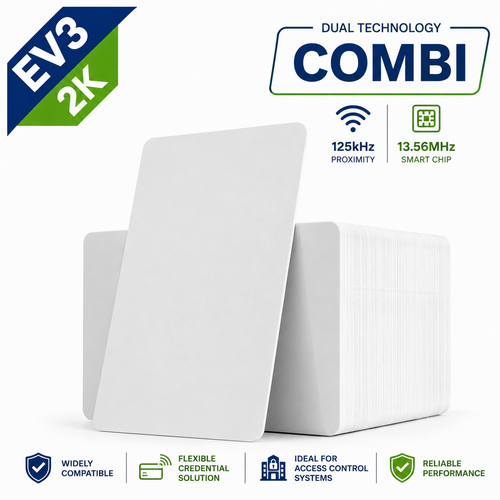
The CDVI ISO25DTH is a dual-technology printable ISO access card combining MIFARE DESFire EV2 4K 13.56 MHz smart-card technology with HID-compatible 125 kHz proximity technology in a single credential. Designed for access control systems that use both modern DESFire readers and existing HID 125 kHz proximity readers, the ISO25DTH helps organizations migrate to higher-security credential technology without requiring users to carry separate cards. Each package contains 25 dual-technology cards.
Dual Technology in One Credential
The ISO25DTH incorporates two access-control technologies within the same ISO-format card:
- MIFARE DESFire EV2 4K operating at 13.56 MHz
- HID-compatible proximity technology operating at 125 kHz
- Supports mixed-reader access control environments
- Allows one credential to work with compatible DESFire and HID proximity readers
- Ideal for phased migrations from legacy 125 kHz systems to higher-security smart-card technology
Key Features
- Manufacturer: CDVI
- Model / Part Number: ISO25DTH
- Credential Type: Dual-Technology ISO Card
- Smart-Card Technology: MIFARE DESFire EV2 4K
- Smart-Card Frequency: 13.56 MHz
- Proximity Technology: HID 125 kHz
- Proximity Frequency: 125 kHz
- Printable ISO card format
- White PVC card construction
- Package Quantity: 25 Cards
Ideal for Access Control Migration Projects
The CDVI ISO25DTH is especially useful for organizations transitioning from traditional HID 125 kHz proximity credentials to MIFARE DESFire EV2. Existing HID-compatible readers can continue operating while newer doors or facilities are equipped with compatible DESFire readers.
Using one dual-technology credential can simplify cardholder management during a phased upgrade and reduce the need to issue separate credentials for different reader technologies.
Printable CR80 / ISO Card Format
The ISO25DTH uses the familiar CR80 / ISO card format commonly used for employee identification and access-control credentials. Its thin card construction allows the credential to function as both an access card and a professionally printed identification badge.
- Approximate dimensions: 3.35" × 2.13" × 0.03"
- Metric dimensions: approximately 85 × 54 × 0.8 mm
- Standard CR80 / ISO card footprint
- Suitable for compatible card-printing applications
- Convenient for photo identification and access control on one card
ISO25DTH vs. Similar CDVI Credentials
| Credential | Technology | Frequency | Best Application |
|---|---|---|---|
| ISO25DTH | DESFire EV2 4K + HID Proximity | 13.56 MHz + 125 kHz | Mixed DESFire and HID 125 kHz environments |
| ISO25DT / ISODT25 | DESFire EV2 + CDVI Proximity | 13.56 MHz + 125 kHz | CDVI 125 kHz and DESFire systems |
| ISOEV2 | MIFARE DESFire EV2 4K | 13.56 MHz | DESFire-only access control systems |
| ISOH25 | HID Proximity | 125 kHz | Legacy HID 125 kHz proximity systems |
Common Applications
- Commercial access control systems
- Corporate offices and campuses
- Healthcare and institutional facilities
- Educational facilities
- Industrial and manufacturing facilities
- Multi-building access control environments
- HID proximity system upgrades
- DESFire EV2 migration projects
- Employee identification and access badges
Compatibility Information
The ISO25DTH is intended for systems requiring both MIFARE DESFire EV2 and HID-compatible 125 kHz proximity technologies. Reader compatibility, credential programming, facility code and card-number requirements should always be verified before ordering.
Important: ISO25DTH should not be confused with CDVI's ISO25DT / ISODT25 credential. The ISO25DTH incorporates HID 125 kHz technology, while the ISODT25 version is designed around CDVI 125 kHz proximity technology.
Why Choose the CDVI ISO25DTH?
For organizations maintaining an existing HID 125 kHz proximity card system while moving toward MIFARE DESFire EV2 technology, the CDVI ISO25DTH provides both technologies in a single printable CR80 credential. It is a practical choice for phased reader upgrades, mixed-technology facilities and installations where one card must support both legacy proximity and newer smart-card access control.