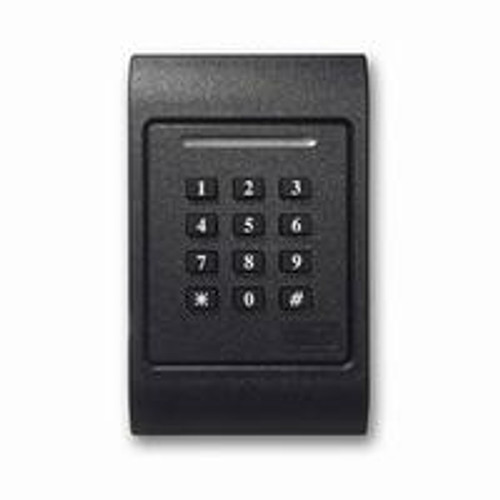
Description
AWID LR-3000 UHF Long-Range RFID Reader for Vehicle Access Control
Up to 25-foot credential reading for automated vehicle identification, gated entrances, parking facilities and secure perimeter access.
Long-Range RFID for Hands-Free Vehicle Identification
The AWID LR-3000 UHF Long-Range RFID Reader is designed for automated vehicle identification (AVI), gated access control, parking systems and other applications requiring convenient hands-free credential reading. Operating in the 902–928 MHz UHF frequency band, the LR-3000 can read compatible AWID UHF tags and cards from distances of up to 25 feet, depending on the credential, reader placement and installation environment.
AWID LR-3000 (LR-3000-B-U) is AWID's long-range UHF reader designed specifically for Automated Vehicle Identification (AVI) and access control applications.
Drivers can enter an authorized gate or parking facility without stopping to lower a window or manually present a card to a short-range reader. This helps improve traffic flow at employee entrances, residential gates, truck yards, distribution centers, corporate campuses and other controlled vehicle-access points.
The reader combines its electronics, RF module and circularly polarized antenna in one compact, IP65-rated weather-resistant enclosure. Simultaneous Wiegand and RS-232 outputs provide flexible integration with compatible access control panels, gate systems, computers and specialized application controllers.
Key Features
- Long-range UHF reading: Up to 25 feet with compatible credentials
- UHF frequency: 902–928 MHz frequency-hopping operation
- Integrated design: Reader electronics, RF module and antenna in one enclosure
- Outdoor protection: IP65-rated weather-resistant housing
- Dual outputs: Simultaneous Wiegand and RS-232 transmission
- Credential formats: Reads AWID credentials from 26-bit through 50-bit formats
- Passive credentials: Compatible tags and cards require no credential battery
- Adjustable RF attenuation: Allows the effective read field to be tailored to the site
- Vehicle-loop integration: Built-in arming wire for use with vehicle presence detection
- Status indication: Built-in LEDs indicate reader power and activity
Ideal Applications
- Automated Vehicle Identification (AVI)
- Gated communities and residential entrances
- Employee and visitor parking facilities
- Commercial parking and garage access
- Corporate campuses and office complexes
- Distribution centers and logistics facilities
- Warehouse, shipping and receiving entrances
- Truck yards and fleet vehicle access
- Industrial plants and secured perimeters
- Transportation terminals and checkpoints
- Passenger cars, trucks, trailers and railcars
- Hands-free ADA door and elevator applications
AWID LR-3000 Specifications
- Technology: UHF RFID
- Frequency: 902–928 MHz
- Read Range: Up to 25 feet
- Frequency Hopping: 125 channels
- Channel Spacing: 200 kHz
- Data Interfaces: Wiegand and RS-232 simultaneously
- Input Voltage: 7–15 VDC
- Protection: IP65 rated
- Operating Humidity: 0–95%, non-condensing
- Compatible Credentials: AWID long-range UHF tags and cards
Actual read range depends on the selected AWID credential, credential orientation, reader mounting, vehicle windshield construction, environmental conditions and nearby metal or RF interference.
Credential and System Compatibility
The LR-3000 is designed for use with compatible AWID long-range UHF credentials, including vehicle-mounted tags, windshield tags and other supported UHF cards or tags. It is not a general-purpose reader for standard 125 kHz proximity cards, 13.56 MHz smart cards or unrelated EPC inventory tags.
Before ordering, confirm the required credential type, bit format, facility code, card-number range and access control panel compatibility. Credential selection and mounting location can materially affect the available read distance.
Installation Considerations
Proper reader positioning is essential for consistent long-range performance. Metal objects, vegetation, people, water, nearby RF equipment and metalized or wire-embedded windshields may absorb or reflect the UHF signal. The reader and credential should be positioned so their faces are approximately aligned within the intended vehicle read zone.
- Allow adequate clearance from metal structures and other materials that may affect RF performance.
- Use the appropriate AWID credential for the vehicle and required reading distance.
- Test the credential location before permanently attaching a windshield or vehicle tag.
- Use shielded cable and follow AWID wiring and grounding instructions.
- Provide a separate, dedicated DC power supply for each LR-3000 reader.
- Consider a vehicle presence sensor to activate the reader only when a vehicle enters the lane.
Why Choose the AWID LR-3000?
The AWID LR-3000 provides a practical upgrade from close-range credential presentation when a facility needs faster vehicle throughput and a more convenient entry experience. Its long-range UHF technology, passive credential support, outdoor-rated enclosure and flexible Wiegand and RS-232 connectivity make it a strong choice for vehicle gates, parking systems, industrial entrances and secure perimeter-access applications.
Frequently Asked Questions
How far can the AWID LR-3000 read a credential?
The LR-3000 can read compatible AWID UHF credentials from distances of up to 25 feet. Actual range varies according to credential type, mounting, orientation and site conditions.
Can the LR-3000 be installed outdoors?
Yes. The reader has an IP65-rated weather-resistant enclosure suitable for properly planned outdoor installations.
Does the LR-3000 work with standard proximity cards?
No. It requires compatible AWID long-range UHF credentials and does not read standard 125 kHz proximity cards or 13.56 MHz smart cards.
What access control outputs does the reader provide?
The LR-3000 provides simultaneous Wiegand and RS-232 outputs for integration with compatible access control panels and application controllers.
Do AWID UHF credentials require batteries?
Compatible passive AWID UHF credentials do not require batteries, helping simplify credential maintenance for vehicle-access applications.
AWID LR-3000 Resources
Review official AWID information, specifications and installation requirements before planning your long-range RFID system.