Bank Access Control: How Security Credentials Protect Employees and Assets
21st Oct 2026
Bank Access Control: How Security Credentials Protect Employees and Assets
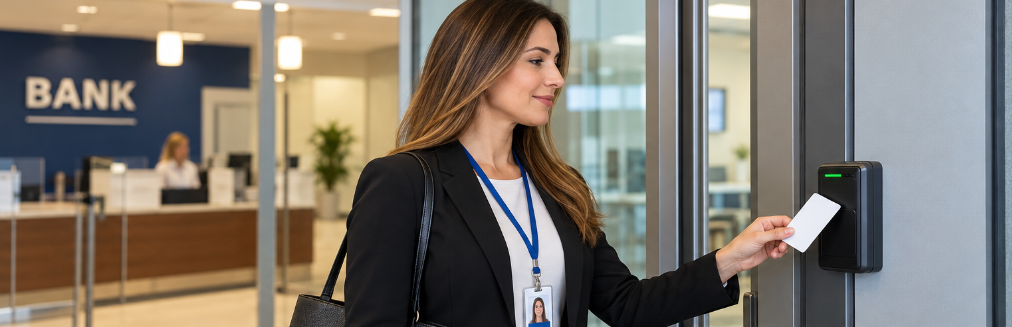
Picture a teller arriving at 7:30 on a Monday morning. She taps her badge. The door clicks open. The system logs her name. Nobody slips in behind her. That quiet moment is bank access control doing its job.
Banks hold cash, customer records, and people who deserve to feel safe at work. A ring of brass keys can't tell you who opened the cash room last Tuesday. A credential can. Below, you'll see how security credentials protect staff and assets, which cards fit which doors, and what examiners expect to find.
What Is Bank Access Control?
At its core, bank access control decides who can enter each part of your building and when. Three pieces make it work: a credential (card, key fob, or badge), a reader beside the door, and software that approves or denies each request.
Think of it as a guest list with a bouncer at every door. During business hours, the lobby welcomes almost anyone. Only staff can reach the teller line. Your vault and server room? Those admit a short list of names, often during set hours only.
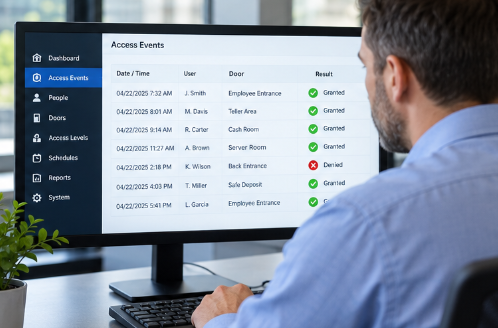
Every tap leaves a record showing the person, the door, and the exact time. If cash goes missing or a back door gets propped open, you won't be guessing. You'll have a timeline.
Why Banks Need Strong Security Credentials
Bank Crime Is Down, Yet Far From Gone
Good news first. The FBI's 2023 Bank Crime Statistics report counted 1,362 robberies, burglaries, and larcenies at federally insured institutions. That figure fell from 1,740 a year earlier. Still, 1,263 of those incidents were robberies. Hundreds of employees faced a terrifying day at work.
Burglaries deserve attention too, with 95 reported in that same year. After-hours break-ins often target back entrances, night drops, and ATM service rooms. Credentials tied to time schedules make those doors much tougher to beat.
The Threat Inside Your Walls
Outside criminals grab the headlines. Insiders frequently cause more harm. The Cybersecurity and Infrastructure Security Agency describes an insider threat as someone using authorized access or knowledge to hurt an organization. Its updated Insider Threat Mitigation Guide now addresses access control, visitor screening, and employee separations directly.
Those incidents are expensive. Research cited in the update put the average annual cost of insider incidents at $17.4 million in 2024. Imagine a fired employee who still holds a working badge, or a contractor whose card never expires. With electronic credentials, you can shut off access in seconds.
Types of Bank Access Control Credentials
Each credential balances cost, convenience, and protection differently. Here's a quick comparison.
|
Credential |
How It Works |
Best Bank Use |
Security |
|
125 kHz proximity card |
Reader picks up a fixed ID number at close range |
Employee entrances, lobby doors, temps |
Basic |
|
Proximity key fob |
Same technology on a keyring |
Staff who skip cards, parking gates |
Basic |
|
13.56 MHz smart card |
Encrypted, two-way check with the reader |
Vaults, cash rooms, server rooms |
High |
|
Photo ID badge |
Printed face and name plus an embedded chip |
All staff for quick visual checks |
Varies by chip |
|
Mobile credential |
Smartphone acts as the card via NFC or Bluetooth |
Managers covering several branches |
High |
Proximity Cards and Key Fobs
Proximity cards remain the workhorse of branch security. They cost little, last for years, and work with readers already mounted on countless walls. HID ISOProx II cards, for example, pair 125 kHz access with a printable surface for photos and logos.
There's a catch. Standard prox cards send an unencrypted number. A determined criminal with cheap equipment can copy one. That's why many banks keep prox credentials for general doors and add stronger options for high-risk rooms.
Smart Cards for High-Security Areas
Smart cards run at 13.56 MHz and rely on encryption. Before a door unlocks, the card and reader confirm each other. Cloning becomes far harder. Technologies like iCLASS SE, Seos, and MIFARE DESFire suit vault anterooms, IT closets, and record storage. Multi-technology cards carry both prox and smart chips, which makes a phased upgrade painless.
Photo ID Badges
A badge showing a face adds a human checkpoint. Tellers can spot a stranger in the back office at a glance. Color coding helps as well: orange for visitors, blue for contractors, white for employees.
How to Plan Access Zones in Your Bank
Strong bank security works in layers. Each zone gets tighter as the value behind the door climbs.
|
Zone |
Examples |
Who Gets In |
Suggested Credential |
|
Public |
Lobby, ATM vestibule |
Customers during set hours, staff |
Prox card for staff |
|
Staff |
Teller line, offices, break room |
All employees |
Prox card or photo badge |
|
Restricted |
Cash room, safe deposit area |
Assigned staff, scheduled hours |
Smart card |
|
High security |
Vault, server room, data closet |
Small named group, dual control |
Smart card plus PIN |
Grab a floor plan and a highlighter. Mark every door, then ask one blunt question for each: who truly needs this? Most banks discover that too many people can open too many rooms. For the vault, consider dual control, where two separate credentials must be presented before the door releases.
Bank Access Control and Regulatory Compliance
Regulators expect more than a locked front door. Under 12 CFR Part 326, FDIC-supervised institutions must appoint a security officer and maintain a written security program. That program covers opening and closing procedures, safekeeping of currency and valuables, and staff training. The security officer also reports to the board at least once a year.
Examiners also rely on the FFIEC IT Examination Handbook, which includes physical security expectations for facilities housing sensitive systems. Here's where credential logs earn their keep. When an examiner asks who entered the server room last quarter, you can produce the answer in minutes.
Best Practices for Managing Bank Security Credentials
Even the best card fails when nobody manages it. These habits keep your system sharp:
- ✔ Grant least privilege. Give each person only the doors their role requires.
- ✔ Revoke access the same day. CISA advises removing physical access and preventing unescorted entry after a departure.
- ✔ Issue expiring badges to contractors. Short-term credentials prevent forgotten access.
- ✔ Review permissions quarterly. Promotions and transfers quietly stack up rights.
- ✔ Audit the logs. Watch for odd-hour entries and repeated denied taps.
- ✔ Lock up spare cards. An unassigned card in a desk drawer is an open door.
- ✔ Stop tailgating. Holding the door for a friendly face defeats the whole system.
Bank Access Control FAQs
What is the best access control credential for a bank?
No single card wins everywhere. Most banks get the best results from layers: proximity cards or photo badges for general staff doors, and encrypted smart cards for vaults, cash rooms, and server closets. Match the credential to the risk behind each door.
Can proximity cards be copied?
Yes. Standard 125 kHz prox cards broadcast an unencrypted number that inexpensive tools can duplicate. They still suit lower-risk doors. For high-value areas, choose 13.56 MHz smart cards with encryption and mutual authentication.
How often should a bank review employee access rights?
Review access lists at least once a quarter. Also check them after any promotion or transfer. Permissions pile up quietly. Regular reviews keep each employee limited to the doors their role requires.
Do federal rules require banks to use access control?
Federal rules require a written security program. 12 CFR Part 326 lists minimum devices such as tamper-resistant exterior locks and an alarm system, plus other devices the security officer finds appropriate. Electronic access control is one of the most practical ways to meet those duties and prove it with logs.
What should happen to a badge when an employee leaves?
Deactivate it in the software on the employee's last day, ideally before the exit meeting ends. Then collect the physical card. Disabling the credential matters most, because an unreturned card is harmless once the system rejects it.
Can a bank upgrade credentials without replacing every reader?
Often, yes. Multi-technology cards carry both a prox chip and a smart chip. They let staff keep using older readers while you swap high-security doors first, spreading the cost out over time.
Secure Your Bank With ID Enhancements
Ready to tighten security at your branches? ID Enhancements has supplied access control credentials for more than 30 years. As a woman-owned company founded in 1993, the team knows that banks can't wait weeks for replacement cards.
That's where RapidPROX® proximity credentials shine. They ship within 24 to 48 hours, with same-day processing available, and arrive programmed to your facility code and bit format. As an authorized HID® reseller, ID Enhancements also stocks smart cards, key fobs, clamshell cards, badge printers, and custom-printed photo IDs.
Whether you're outfitting one branch or fifty, you'll find the products that you need to secure your business. Call 1.800.279.4560 or visit id-enhancements.com to talk with a credential specialist today.